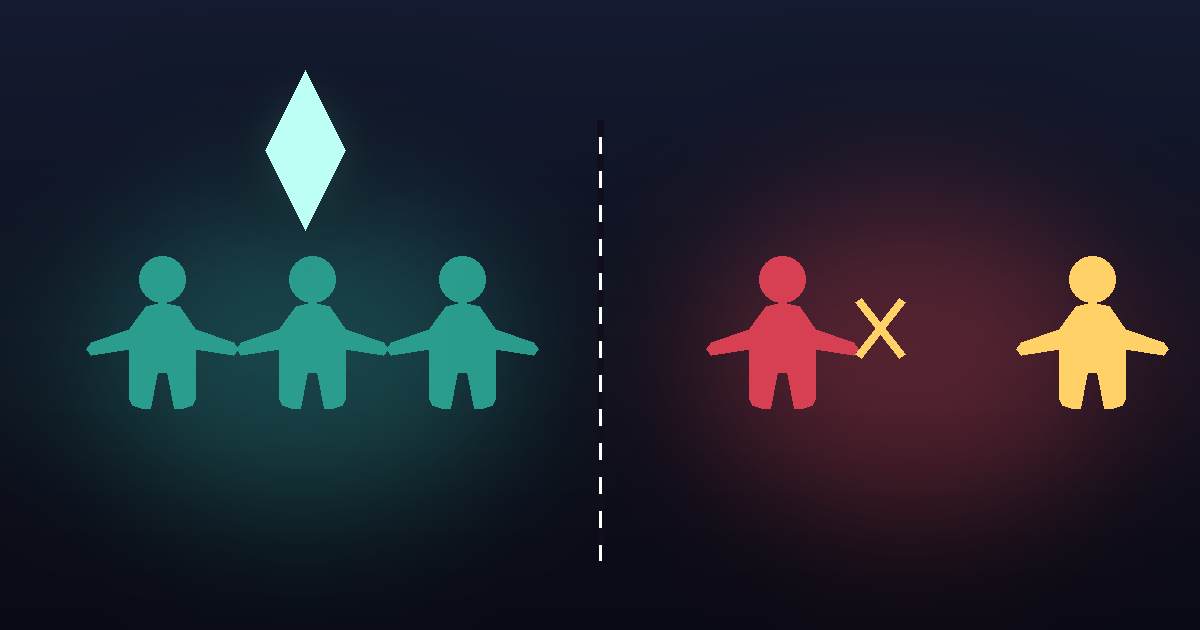
Most board game advice starts with a list. This is the decision that comes before the list, and getting it wrong is the most common reason a well-chosen game never gets played twice.
In a competitive game you are trying to beat the other players. In a cooperative one you are all playing against the game itself, and you win or lose together. That sounds like a matter of taste. In practice it changes what an evening feels like far more than the theme or the rules ever will.
What cooperative games actually solve
They fix specific social problems, and if your table has one of these, co-op is not a preference — it is the answer.
Nobody gets targeted. In a competitive game, the leader gets attacked. That is correct play, and it is also how family arguments start. Co-op removes the entire category.
Nobody gets eliminated. No sitting out for forty minutes watching other people enjoy themselves.
Teaching is natural. A new player can be advised openly, without anyone wondering whether the advice was self-serving. This is why co-op games are so good for mixed groups — a child, a grandparent and a hobbyist can share one table honestly.
Losing is shared. The game beat us, rather than you beat me. For some people that is the entire difference between a good evening and a sour one.
Where to start:
- Pandemic — the one everyone means by “cooperative game”. Cure four diseases before they spread. Still the clearest introduction to the format.
- Forbidden Island — the same designer, lighter, cheaper and shorter. A better first purchase if there are children at the table.
- The Crew: The Quest for Planet Nine — a trick-taking card game where you must win specific tricks, with almost no communication allowed. Tiny box, fifty missions, very hard to put down.
- Sky Team — two players landing a plane, mostly in silence.
- Spirit Island — the heavy end. Genuinely difficult, and the co-op that strategy players respect.
The failure mode nobody warns you about
Cooperative games have one serious flaw, and it is worth knowing before you buy: the alpha player problem.
Because all information is open and the group shares one outcome, the most experienced player can simply work out the best move for everybody — and then say it. Now one person is playing a puzzle and everyone else is moving pieces for them. It is rarely malicious. It is just what happens when someone cares about winning and the rules permit them to direct the table.
Two mitigations, both built into the games above. The first is limited communication: The Crew and Sky Team forbid most of it outright, which makes dominating the table impossible by design. The second is asymmetric roles: when each player has powers and information nobody else fully understands, nobody can plan everyone’s turn.
The smaller flaw: a co-op is a puzzle, and puzzles get solved. Once a group reliably wins, a competitive game usually has more life left in it.
What competitive games give you
Real stakes. Wanting to win is the engine that makes the decisions matter. Co-ops replace that with a difficulty dial, which is not quite the same thing.
Replayability. The other players are the variable content, and they change every time. This is why a good competitive game survives a hundred plays while a co-op campaign ends.
Reading people. Negotiation, bluffing and knowing when someone is desperate — none of which exists when everyone is on the same side.
Worth knowing: competitive does not mean confrontational. There is a large middle ground where you compete for the same resources but never attack anyone directly — sometimes called multiplayer solitaire, usually as a compliment. Azul, Wingspan, Cascadia and Terraforming Mars all let you compete hard without anybody feeling picked on. If your table dislikes conflict but still wants to win, this is the shelf you want — not co-op.
The middle ground
Two formats sit between, and both are worth knowing because they solve particular problems:
Traitor games. Mostly cooperative, except one player is secretly working against the group. Dead of Winter and Betrayal at House on the Hill both do this, and it neatly cancels the alpha player problem — you cannot follow someone’s instructions when they might be the saboteur. The cost is paranoia, which some groups find delicious and others find exhausting.
Team games. One Night Ultimate Werewolf and similar hidden-role games give you competition between teams rather than individuals, which spreads the sting of losing across several people.
So which does your group need?
| If your table… | Choose |
|---|---|
| Has someone who takes losing badly | Cooperative |
| Mixes adults and young children | Cooperative |
| Is teaching a new player tonight | Cooperative |
| Has one much more experienced player | Co-op with limited communication, or competitive |
| Wants the same box to last for years | Competitive |
| Enjoys arguing, bluffing and needling | Competitive |
| Dislikes conflict but still wants to win | Competitive, low-interaction |
If you are buying your group’s first game and genuinely cannot tell, start cooperative. The downside of a co-op that turns out too easy is a mild shrug. The downside of a competitive game in a group that could not handle it is that nobody suggests a board game again for a year.
Next
The other number that decides whether a game fits your table is complexity — what a game’s “weight” actually means covers how to read it and why the figure on a game’s page is more useful than the age on the box.
Or skip ahead and set your own filters for player count, age and experience.